 Pallas
Reading 13 of 14 · Indiana Grade 4 Social Studies
How Indiana's State Government Works
Read the story told here and take notes on the Narrative Notes Template provided by your teacher.
Chapter One: Julia Nelson Decides to Run

In January 1920, Indiana lawmakers approved the 19th Amendment. This gave American women the right to vote. That November, Hoosier women lined up at the polls for the very first time. In Indianapolis alone, more than 71,000 of the city's 76,000 registered women showed up to vote. Down the road in Indianapolis, the Indiana General Assembly — the group of lawmakers who write Indiana's laws — kept working on bills about schools, roads, and more. Now more Hoosiers than ever were paying attention to who got to write those laws.
In Muncie, Indiana, a woman named Julia Nelson decided she would not just vote. She would run for office herself. No woman had ever served in the Indiana General Assembly before. Julia Nelson wanted to be the first. She set her sights on a seat in the Indiana House of Representatives, one of the two parts of the General Assembly. She would carry her neighbors' voices all the way to the Statehouse.
Chapter Two: Julia Nelson Campaigns Door to Door
Julia Nelson spent weeks walking through her district in Muncie. She knocked on doors and talked with the people she hoped to represent. At each doorstep, she listened to what her neighbors cared about. They talked about their children's schools, their roads, and the laws being debated in Indianapolis. She told them what she would fight for if they sent her to the Statehouse. Her opponent worked just as hard, meeting voters and sharing his own ideas. All across the district, people who had never followed an election so closely began to pay attention.
Julia Nelson kept knocking, kept listening, and kept showing up. On election night, voters across her district cast their ballots. When the votes were counted, Julia Nelson had won. She had earned a seat in the Indiana House of Representatives. Young people in the neighborhood had watched the whole campaign. They saw that their community's votes had decided who would speak for them at the Statehouse.
Chapter Three: Julia Nelson Takes Her Place
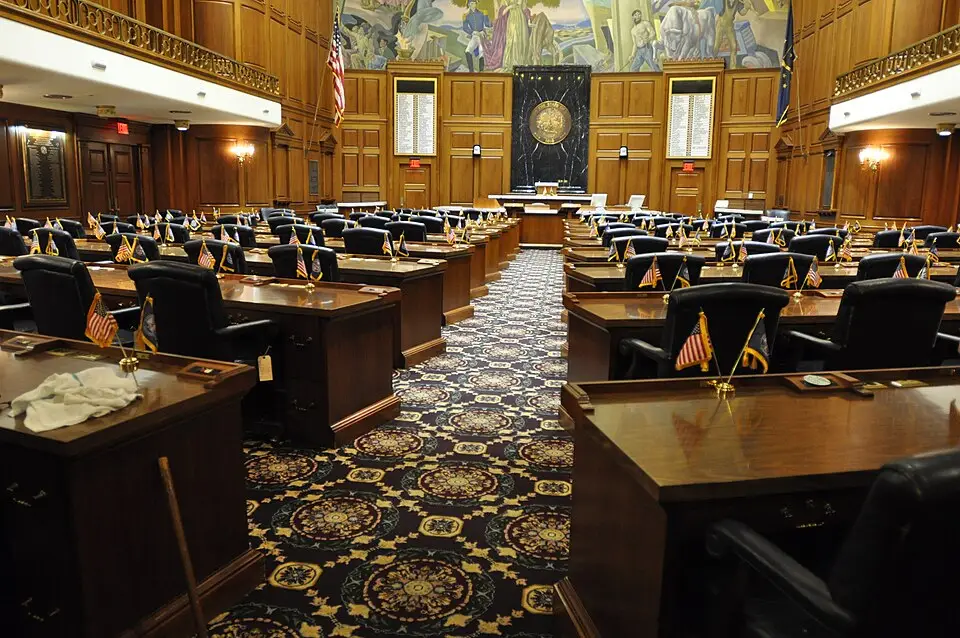
In 1921, Julia Nelson traveled to Indianapolis. She took her seat in the Indiana General Assembly. She became the first woman ever to serve there. She joined a House of Representatives that could hold up to one hundred members, plus a Senate that could hold up to fifty. Alongside her worked the governor, the attorney general, and other officials who helped run the state. Nelson got right to work. She helped write bills and watched lawmakers argue over them in committee, a small group that studies a bill closely before the whole House votes on it.
Nelson learned that even a good idea could face a long road. A bill had to pass both the House and the Senate before it reached the governor's desk. The governor could sign it into law. Or the governor could veto it, which means send it back unsigned. If enough lawmakers still believed in the bill, the House and Senate could vote again to override that veto and make it law anyway. Back home in Muncie, neighbors who had watched Nelson's campaign held a meeting to talk about her work at the Statehouse. They had learned something they would not forget. Every single vote, including the vote of a woman casting her ballot for the very first time, had helped decide who sat in the halls of Indiana's government.