 Pallas
The New York City Draft Riots and the Colored Orphan Asylum 4th grade · age 9
 By Simit Patel · published October 25, 2026
Read the story told here and take notes on the Narrative Notes Template provided by your teacher.
Chapter One: Congress Passes a Draft Law That Divides New York
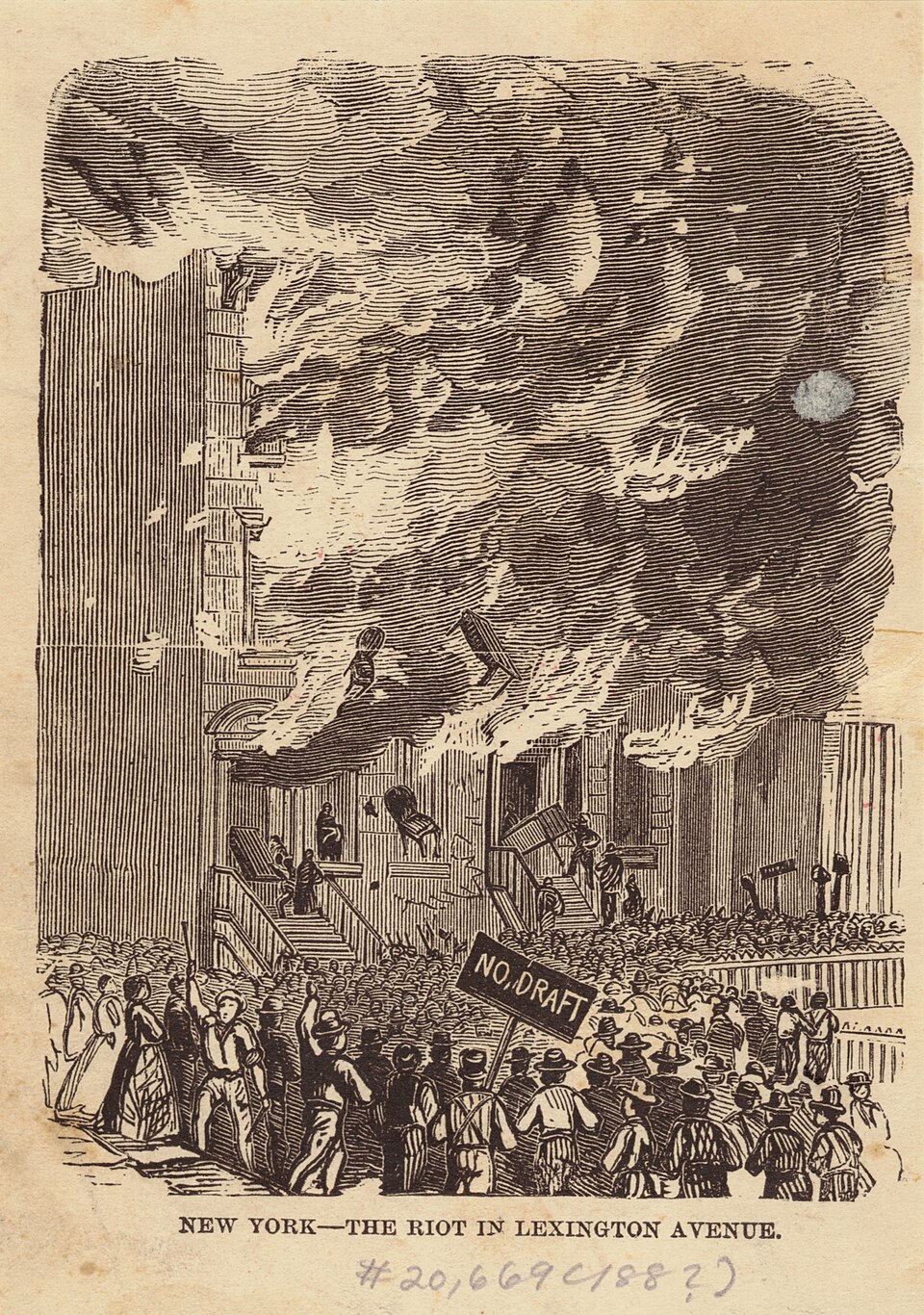
In March 1863, the United States was deep in a terrible civil war (a war between two groups inside the same country). In this war, the Northern states, called the Union, were fighting the Southern states, called the Confederacy. The Union army, which fought for the North, needed more soldiers, so they passed a new law. For the first time ever, the Union government could force people to join the military. Officials would pick men's names out of a list and tell them they had to go fight. But the Union law had a special escape: any man whose name was picked could pay three hundred dollars and stay home. That was as much money as a working man earned in a whole year. A wealthy man could easily pay his way out, but a poor man had no choice. He had to go and fight.
In New York City, which was in the North and thus a part of the Union, Irish American workers were some of the angriest people of all. They already struggled to feed their families. Now the draft law said they would have to risk their lives in a war while rich men stayed safely home. Antiwar newspapers made things worse. They told Irish workers that if enslaved Black people were freed, Black workers would come up north and take their jobs. The unfairness, the money troubles, and the racism made many Irish American workers furious.
On Fifth Avenue between Forty-Third and Forty-Fourth Streets stood the Colored Orphan Asylum. It was a home for Black children, founded by Quaker women in 1836. The staff cared for two hundred and thirty-three children in a large four-story building. They raised and educated the children in playrooms, classrooms, and sleeping rooms. Even as anger over the draft spread across the city that summer, the staff kept watch over those children day after day, feeding them, teaching them, and trying to keep life inside the asylum safe and normal. The asylum was one of the clearest signs that some White New Yorkers cared for children of color. That alone would soon make it a target.
Chapter Two: Rioters Burn the Orphan Asylum on Fifth Avenue
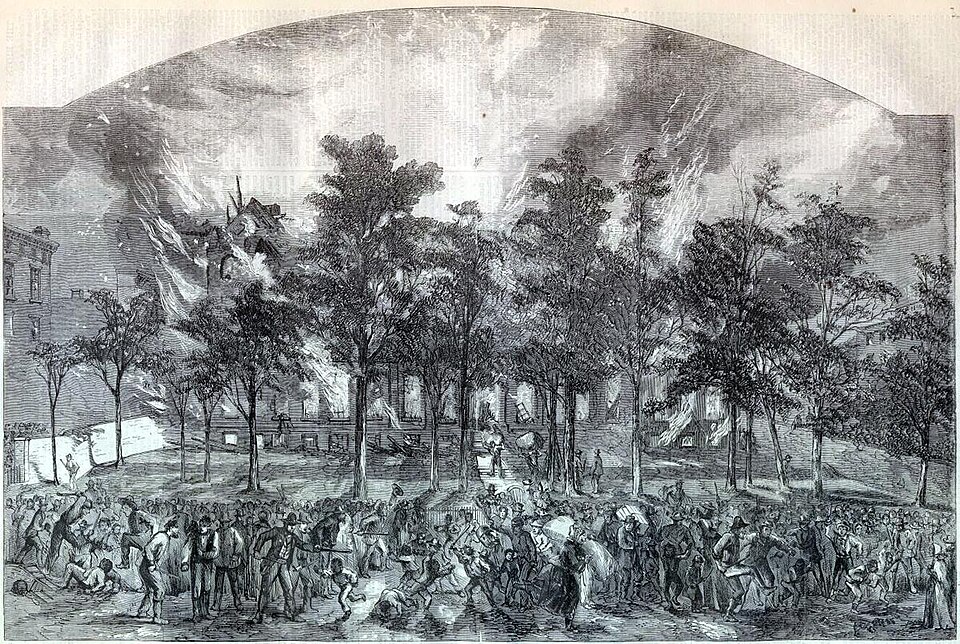
That anger finally exploded on July 13, 1863. That morning, army officers on Second Avenue began pulling draftees' names from a large wooden wheel. An angry mob threw bricks through the windows and stopped the drawing. The rioters were angry about a rule in the draft law that let wealthy men pay three hundred dollars to skip military service. People in the crowd also believed that Black workers would take their jobs. The mob moved through Manhattan, growing bigger. Along the way, rioters beat and killed Black New Yorkers in the streets, stole from stores, and attacked the offices of newspapers that supported the Union.
That afternoon, the mob turned toward the Colored Orphan Asylum. The asylum was a home for Black children, and the rioters hated that White people had built it to care for them. That hate made the asylum a target. The rioters broke down the front door with an axe and rushed inside. But the children were not there to meet them. While the crowd was busy at the front, the superintendent, William Davis, and the head matron, Jane McClellan, made a quick choice. They quietly led all the children out the back door. As they left, one little girl picked up the family Bible. "Mr. Davis, I've got the Bible," she said. She carried it with her the whole way. The children walked to a police station, where they were safe. Behind them, the rioters grabbed everything they could carry: chairs, beds, blankets, and even baby clothes. Then they set the asylum building on fire. Brave firefighters came to put out the flames, even though the mob threatened them. But the fire was too strong, and the building was destroyed. The children stayed at the police station until the danger passed. Then they were taken to Blackwell's Island, an island in the East River. All of them were alive, but the home they had known was gone.
Chapter Three: Black New Yorkers Flee and the Asylum Never Returns
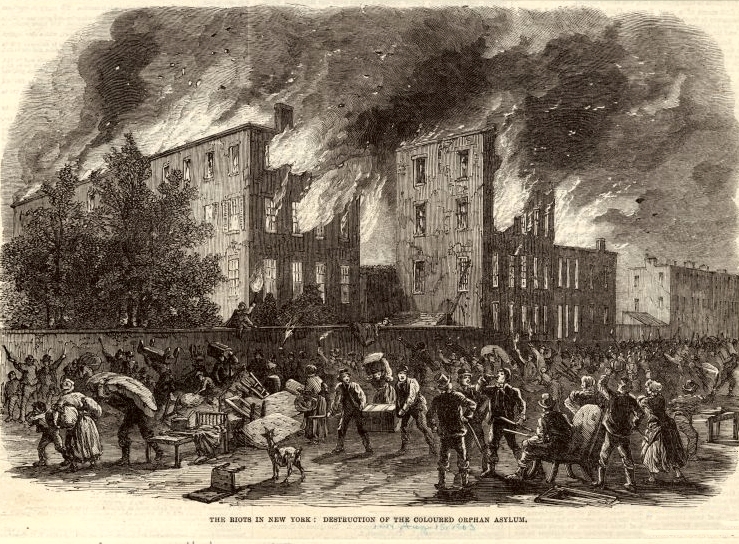
The asylum was not the only target that week. All across Manhattan, rioters kept attacking Black New Yorkers. Finally, soldiers came from Gettysburg, Pennsylvania, where they had just fought a big battle. They marched into the city and stopped the violence. But by then, the damage was done. Black New Yorkers had been beaten and killed simply because of the color of their skin. In the weeks that followed, thousands of Black residents packed up and left the city as they no longer felt safe where they were. Some moved to Brooklyn or New Jersey, while others started new communities far uptown. By the time the city grew quiet again, fewer Black people lived in New York than at any time in more than forty years. The rioters had not only destroyed homes and lives; they had driven an entire community out of the city.
The orphanage's leaders tried to rebuild on Fifth Avenue, but neighboring residents pushed them to go somewhere else. As a result, the asylum was forced farther and farther from its original home. First they moved to a small temporary building on Fifty-First Street. Then, in 1867, they moved to a permanent orphanage on 143rd Street, nearly a hundred blocks north of where the children had once lived. William Davis and Jane McClellan had saved every one of the two hundred and thirty-three children, but the board could never bring them back to Fifth Avenue. None of the rioters who destroyed the asylum were ever punished. There is still no marker at the spot today. In April 2026, the New York City Council heard a bill called Intro 496. It asks for a study of ways to mark the draft riots. The bill is still waiting in a committee (a small group that looks at a bill first). So what should a marker say?
Standards this lesson meets
- 4.5c The United States became divided over several issues, including slavery, resulting in the Civil War. New York State supported the Union and played an important role in this war.Chapters 1, 2 and 3: The reading explains that the nation divided over issues including slavery into the Civil War, with New York City part of the Union and events in the city tied to the draft that supplied Union soldiers.
- A.2 Recognize, use, and analyze different forms of evidence used to make meaning in social studies (including sources such as art and photographs, artifacts, oral histories, maps, and graphs).Chapters 1, 2 and 3: Each chapter presents period illustrations of the riots and burning asylum that students can analyze as visual evidence.
- B.3 Identify the relationship between multiple causes and multiple effects, using examples from his/her life or from a current event or history.Chapters 1 and 2: The reading lays out multiple causes of the riots (the unfair $300 draft exemption, poverty, and racist fears of job competition) and their multiple effects (deaths, the asylum's destruction, and Black residents fleeing).
- B.4 Distinguish between long-term and immediate causes and effects of a current event or an event in history.Chapters 1 and 2: The reading distinguishes long-building anger over the draft law and racism from the immediate spark of names being drawn on July 13, 1863.
- C.2 Identify multiple perspectives on an historical event.Chapters 1 and 2: The reading presents the perspectives of angry Irish American workers, the asylum staff who protected the children, and Black New Yorkers who were attacked.
- C.5 Describe historical developments in New York State with specific detail, including time and place.Chapters 1, 2 and 3: The reading describes the draft riots with specific times and places, from March and July 1863 on Fifth Avenue and Second Avenue through the 1867 relocation to 143rd Street.
- F.7 Identify people in positions of power and how they can influence people’s rights and freedom.Chapter 1: The reading shows how Congress and Union officials in power created a draft law whose $300 exemption favored the wealthy and forced the poor to fight, shaping people's freedom.