 Pallas
Ida Tarbell Takes On Standard Oil 6th grade · age 11
 By Simit Patel · published November 18, 2026
When Ida Tarbell published her investigation of Standard Oil in McClure's Magazine, what did she think she was doing, and why did she believe the public needed to know how Rockefeller built his company?
The source
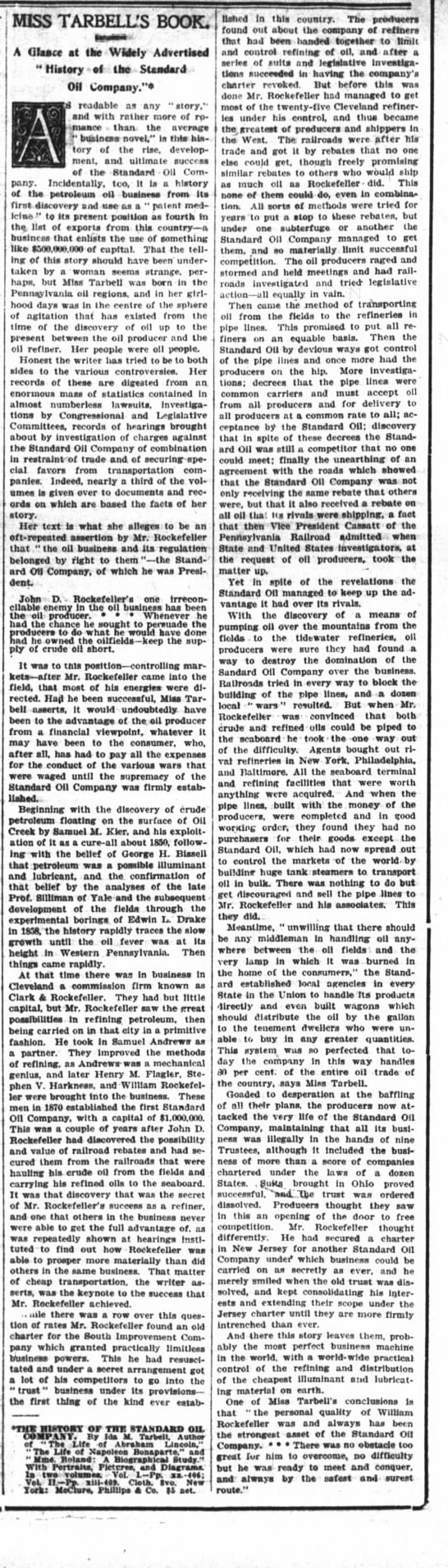
Miss Tarbell's Book: A Glance at the Widely Advertised "History of the Standard Oil Company"
About this document
As the reading described, Ida Tarbell spent nearly two years publishing her massive investigation of Standard Oil in McClure's Magazine — nineteen parts in all, from November 1902 to October 1904. She dug through government records, court documents, and interviews to show how John D. Rockefeller had used secret railroad rebates, spying, and ruthless tactics to crush competitors and build his monopoly. In 1904, her articles were collected into a book called The History of the Standard Oil Company, and it became a sensation across the country.
On December 31, 1904, The New York Times published a review of Tarbell's book. The review summarized how Rockefeller got secret shipping discounts from the railroads, bought out twenty-five competing refineries in Cleveland, and took control of pipelines and markets until almost no one could compete with him. The reviewer noted that Tarbell had been born in the Pennsylvania oil region and that her family were "oil people," and praised the enormous amount of evidence — lawsuits, government hearings, and official records — that she used to back up her story.
Miss Tarbell was born in the Pennsylvania oil regions, and in her girlhood days was in the centre of the sphere of agitation that has existed from the time of the discovery of oil up to the present between the oil producer and the oil refiner. Her people were oil people. Honest the writer has tried to be to both sides to the various controversies.
Her text is what she alleges to be an oft-repeated assertion by Mr. Rockefeller that 'the oil business and its regulation belonged by right to them' — the Standard Oil Company, of which he was President.
It was that discovery [of railroad rebates] that was the secret of Mr. Rockefeller's success as a refiner, and one that others in the business never were able to get the full advantage of... That matter of cheap transportation, the writer asserts, was the keynote to the success that Mr. Rockefeller achieved.
The oil producers raged and stormed and held meetings and had railroads investigated and tried legislative action — all equally in vain.
And there this story leaves them, probably the most perfect business machine in the world, with a world-wide practical control of the refining and distribution of the cheapest illuminant and lubricating material on earth.
Glossary
- agitation n.
- angry public protest or unrest (excerpt 1)
- controversies n.
- strong public disagreements (excerpt 1)
- alleges v.
- claims something is true (excerpt 2)
- railroad rebates n.
- secret discounts that railroads gave to certain companies for shipping goods (excerpt 3)
- legislative action n.
- trying to get lawmakers to pass new laws (excerpt 4)
- in vain adv.
- without success; uselessly (excerpt 4)
- illuminant n.
- a substance used to produce light, such as lamp oil (excerpt 5)
- lubricating adj.
- used to make machine parts slippery so they run smoothly (excerpt 5)
The New York Times. “Miss Tarbell's Book: A Glance at the Widely Advertised "History of the Standard Oil Company".” The New York Times, 1904-12-31, https://www.newspapers.com/image/20419368/#nyt-1904-12-31-p18-miss-tarbells-book. (subscription)
Your turn
Setting the scene
What has happened in our unit story by the time this document was created?
What does it say?
In paragraph one, where did Tarbell grow up, and what does the reviewer say she tried to do in her writing?
In paragraph two, what does Tarbell say Rockefeller repeatedly claimed about the oil business?
In paragraph three, what does Tarbell say was the real secret behind Rockefeller's success as a refiner?
In paragraph four, what did the oil producers do to try to fight back, and how well did it work?
In paragraph five, what does the reviewer say Standard Oil still controlled at the end of the story?
What does it mean?
In paragraph three, Tarbell calls the railroad rebates a 'secret' that others 'never were able to get.' Why does she use the word 'secret' instead of just saying Rockefeller got a better deal — what does she want readers to think about how he built Standard Oil?
In paragraphs four and five, Tarbell shows that the oil producers tried everything to fight back but failed, and that Standard Oil still controlled the industry at the end. Why does she end her story this way — who is she trying to convince, and what does she want them to do?
What did the author assume?
Which assumption about how businesses should succeed do you think The New York Times reviewer (summarizing Tarbell's argument) would agree with?
A. A company that succeeds by making secret deals that its competitors cannot access has not earned its success fairly.
B. A company that succeeds by making secret deals is simply being smarter than its competitors, and that success is well earned.
Which assumption about what ordinary people can do against a powerful company do you think The New York Times reviewer (summarizing Tarbell's argument) would agree with?
A. When ordinary people cannot stop a powerful company on their own, public awareness through journalism can help force change.
B. When ordinary people cannot stop a powerful company on their own, there is nothing anyone — including journalists — can really do about it.
Write your answer
Use The New York Times's review of Tarbell's book to answer our question: When Ida Tarbell published her investigation of Standard Oil in McClure's Magazine, what did she think she was doing, and why did she believe the public needed to know how Rockefeller built his company?
From Ida Tarbell Takes On Standard Oil, a 6th grade history lesson on Pallas.